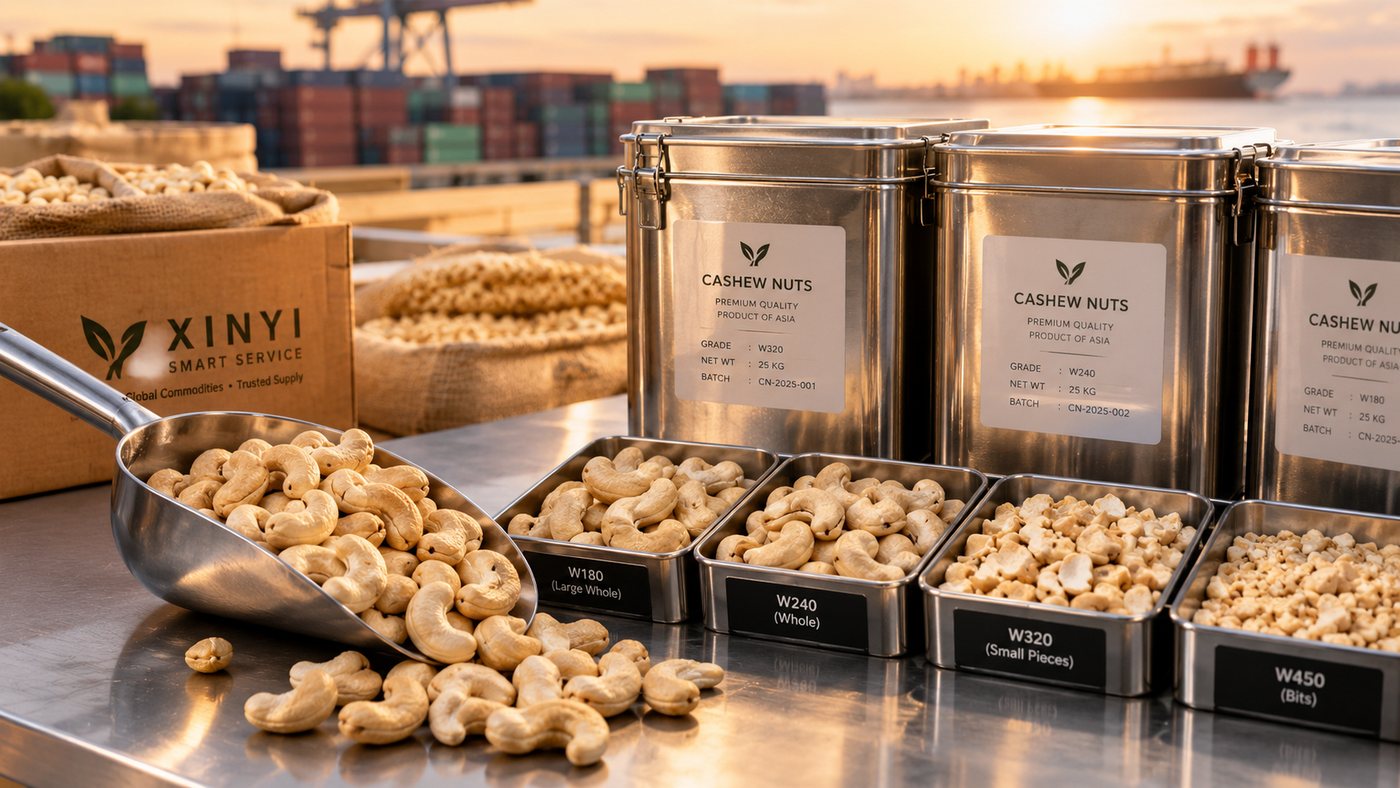
Cashew Grades W240 vs W320 Explained
A cashew grade is a size and a colour, nothing more. Understanding that is the difference between buying appearance and buying yield.
Reading the code
In the standard cashew grading system the letter describes colour and wholeness, and the number describes size. W means white whole kernel. The number is the approximate count of kernels per pound, so W240 gives around 240 kernels to the pound and W320 around 320. A higher number means a smaller nut. SW means scorched whole — the same size, a darker colour from over-roasting during shelling, and a lower price for identical eating quality.
Where the price sits
W180 and W210 are the showpiece grades: large, expensive, bought for gift tins and premium retail. W240 is the upper commercial grade. W320 is the most traded grade in the world and the reference point most price discussions start from. W450 is the smallest white whole. Below that you are into butts, splits, large white pieces and small white pieces.
When to buy pieces instead of wholes
If the kernel is going into a nut butter, a praline, a bakery inclusion, a cereal or a ground product, nobody sees the shape and paying for wholeness is pure waste. Splits and large white pieces deliver the same protein, the same fat and the same flavour at a meaningful discount. Buy wholes when the consumer looks at the nut, buy pieces when they do not.
The specification that protects you
Moisture at five per cent maximum, because cashew above that will not hold twelve months. Broken and defective at five per cent maximum on whole grades. Foreign matter nil. Vacuum packing under nitrogen in tins of 22.68 kilograms — the old fifty-pound tin, still the trade standard — and a stated aflatoxin limit tested by a named laboratory.
Aflatoxin is where contracts fail
The European Union limits total aflatoxin on nuts for direct consumption to four parts per billion, which is far tighter than most other markets. If your cargo is destined for the EU, that figure belongs in the contract, tested at origin by an accredited laboratory before shipment. Discovering a problem at the destination port is expensive in a way that testing at origin never is.
Where these rules are published.
The bodies that set the grades, limits and contract forms referred to above. Links go straight to the issuing authority.
Keep reading.


Tell us what you need to buy.
Send the commodity, specification, quantity, destination port and Incoterm. A firm offer comes back within 48 hours.