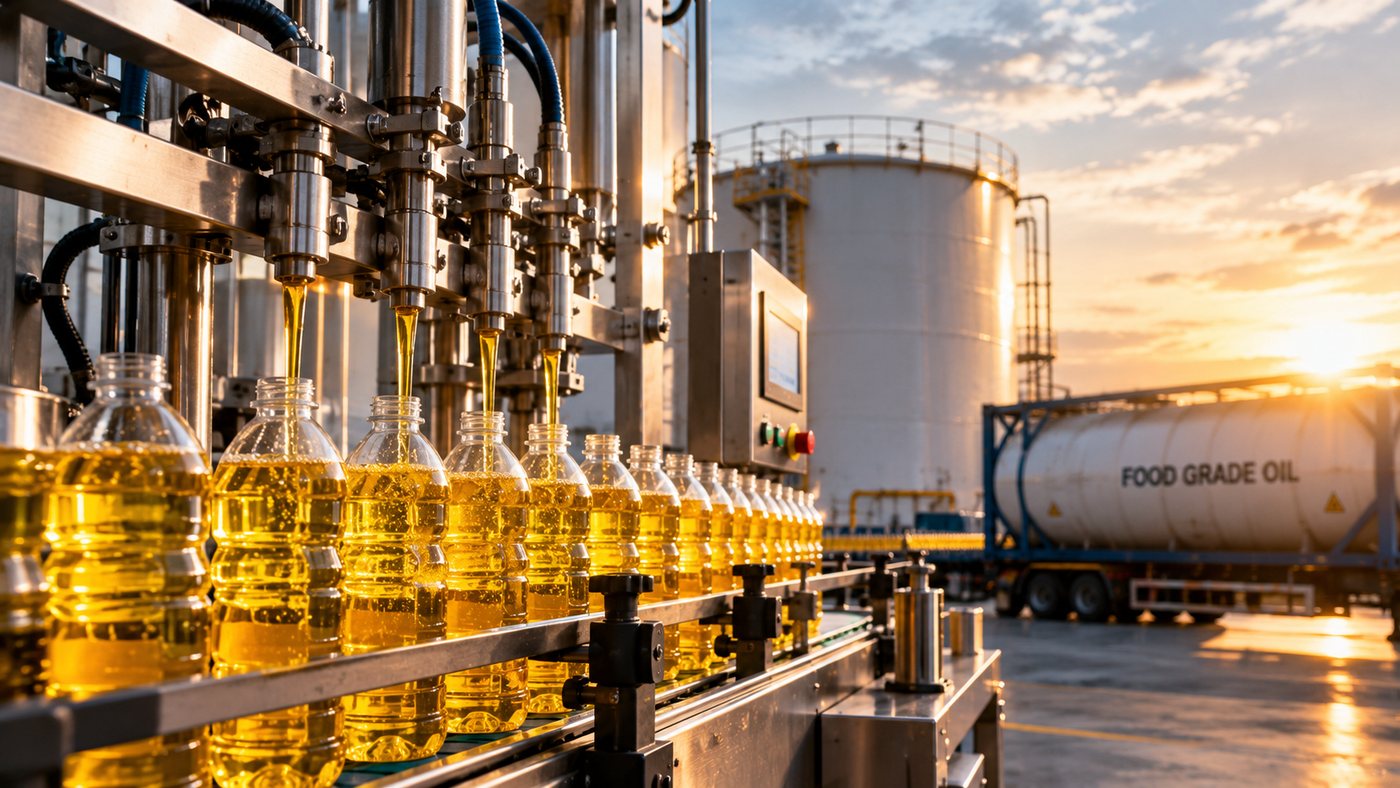
CP6, CP8 and CP10 Palm Olein Compared
The number after CP is a temperature, not a quality score. Buying a colder grade than your market needs is one of the easiest ways to overpay for cooking oil.
What the number actually means
CP stands for cloud point: the temperature at which the first crystals appear and the oil goes hazy. CP10 clouds at ten degrees Celsius, CP8 at eight, CP6 at six. Nothing about the number describes purity, refining quality or shelf life. It describes cold behaviour, and cold behaviour only.
How the grades are made
Palm oil is a natural mix of a liquid fraction, olein, and a solid fraction, stearin. Controlled cooling crystallises the stearin, which is filtered off, leaving a more liquid olein behind. Do this once and you get standard olein at around CP10. Fractionate the olein again and you get CP8. A third pass gives super olein at CP6. Each pass costs energy and yields less liquid, which is why the price rises as the number falls.
Choosing a grade by destination
In tropical and equatorial markets — most of West Africa, South and Southeast Asia, the Gulf in summer — ambient temperature almost never approaches ten degrees, so CP10 stays perfectly clear on the shelf and buying CP8 is money spent on nothing. In markets with a real winter, or where the product will sit in an air-conditioned supermarket or a chilled logistics chain, a cloudy bottle reads to the consumer as spoiled, and CP8 or CP6 earns its premium. If the oil is going into a fryer or a soap plant rather than a retail bottle, cloud point is largely irrelevant.
What else to write into the contract
Cloud point alone is not a specification. Free fatty acid at 0.1 per cent maximum, moisture and impurities at 0.1 per cent, Lovibond colour at 3.0 red maximum in a five and a quarter inch cell, and iodine value are the figures that decide whether you receive good oil. Add a cold test in hours if the destination is genuinely cold, and name the laboratory and the sampling method.
A rule of thumb
Specify the warmest cloud point your market can carry without complaints, then hold the refiner to the full set of quality parameters rather than to the CP number alone. That combination — a realistic cloud point and a tight FFA, moisture and colour spec — is what separates a good palm olein contract from an expensive one.
Where these rules are published.
The bodies that set the grades, limits and contract forms referred to above. Links go straight to the issuing authority.
Keep reading.


Tell us what you need to buy.
Send the commodity, specification, quantity, destination port and Incoterm. A firm offer comes back within 48 hours.